Boeing B-17 ‘Flying Fortress’



In June 1934 Boeing began work on a four-engined heavy bomber in response to a US Army Air Corps request. The B-17 (Model 299) prototype was built as a private venture, financed entirely by Boeing, and went from design board to flight test in less than 12 months.
The B-17 was a low-wing monoplane that combined aerodynamic features of the XB-15 giant bomber, still in the design stage, and the Model 247 transport. The B-17 was the first Boeing military aircraft with a flight deck instead of an open cockpit and was armed with bombs and five .30-caliber machine guns mounted in clear "blisters."
Initial production up to the B-17D was only in small numbers, for these first variants were in effect pre-production batches to evaluate the type's steadily improving capabilities. The company's gamble with the prototype eventually paid off, however, in production of 12,731 aircraft of all variants.
The first B-17s saw combat in 1941, when the British Royal Air Force took delivery of several B-17s for high-altitude missions. As World War II intensified, the bombers needed additional armament and armor.
The B-17E, the first mass-produced model Flying Fortress, carried nine machine guns and a 4,000-pound bomb load. It was several tons heavier than the prototypes and bristled with armament. It was the first Boeing airplane with the distinctive — and enormous — tail for improved control and stability during high-altitude bombing. Each version was more heavily armed. The B-17F was an improved B-17E, and the final B-17G (8,680 aircraft) was the definitive model with a chin turret to deter head-on fighter attacks.
The Flying Fortress operated in several theaters. In the Pacific, the planes earned a deadly reputation with the Japanese, who dubbed them "four-engine fighters." However the B-17 is probably best remembered as the mainstay of the 8th Army Air Force in its daylight raids against Germany with steadily strengthened fighter escort.
The Fortresses were also legendary for their ability to stay in the air after taking brutal poundings. They sometimes limped back to their bases with large chunks of the fuselage shot off.
Boeing plants built a total of 6,981 B-17s in various models, and another 5,745 were built under a nationwide collaborative effort by Douglas and Lockheed (Vega). Only a few B-17s survive today; most were scrapped at the end of the war. Some of the last Flying Fortresses met their end as target drones in the 1960s — destroyed by Boeing Bomarc missiles.
B-17 ‘Sally B’ Click picture for better view.
©Nigel Harrison 2004
|
|
|
|
United States of America |
|
|
|
|
|
Long range, heavy bomber |
|
|
|
|
|
July 28, 1935 |
|
|
|
|
|
Boeing: 6,981 plus 5,745 built under license (wartime) |
|
|
|
|
|
Four 1,200-hp (895-kW) Wright R-1820-97 radial piston engines (B-17G) |
|
|
|
|
|
maximum speed 302 mph (486 km/ h) at 25,000 ft (7,620 m); climb to 20,000 ft (6,095 m) in 37 minutes 0 seconds; service ceiling 35,600 ft (10,850 m); range 3,400 miles (5,470 km). |
|
|
|
|
|
empty 36,135 lb (16,391 kg); maximum take-off 72,000 lb (32,660 kg) (B-17G) |
|
|
|
|
|
span 103 ft 9.25 in (31.62 m); length 74 ft 9 in (22.78 m); height 19 ft 1 in (5.82 m); wing area 1,420.0 sq ft (131.92m2) |
|
|
|
|
|
13 0.5-in (12.7-mm) machine guns in chin, cheek, dorsal, ventral, beam and tail installations, and up to 17,600 Ib (7,983 kg) of bombs (B-17G) |
|
|
|
|
|
2 pilots, bombardier, radio-operator, 5-6 gunners (B-17G) |
|
|
|
|
|
|











![B-17s on the flight line [Boeing.com]](../assets/images/b-17airstrip.jpg)
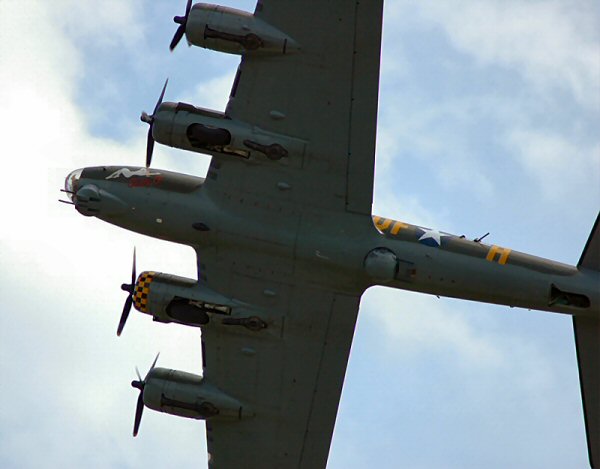
B-17 ‘Sally B’ ©Nigel Harrison 2004
|
|
|
|
Free Download at flightsim.com |
|
|
|
|
|
m_belle.zip (3.4 Mb) |
|
|
|
|
|
Model by: Alphasim repaint/update By Lennart Biermann. |
|
|
|
|
|
|
|
|
|
|
|
FS2002 Boeing B-17F Memphis Belle. |
|
|
|
|
|
|
|
|
|
|
|
Recommended panel is b17panel.zip for FS2004 (24.3 Mb) |
|
|
Recommended sound is B17SNDPK.ZIP. (27 Mb) |


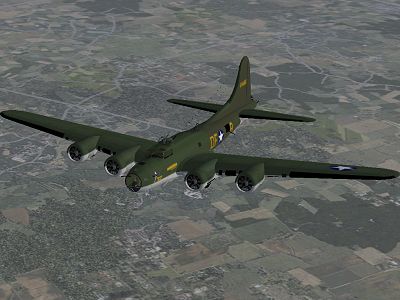
B-17F screenshot in FS2004. Propellor’s would be visible in FS2002.